
Canadian Salmon, Canadian-Made Salmon Feed, A Strong & Sustainable B.C. Salmon Farming Industry
B.C. salmon feed is made locally from mostly Canadian ingredients. The federal government's 2029 salmon farming ban would replace it with higher-carbon imports.
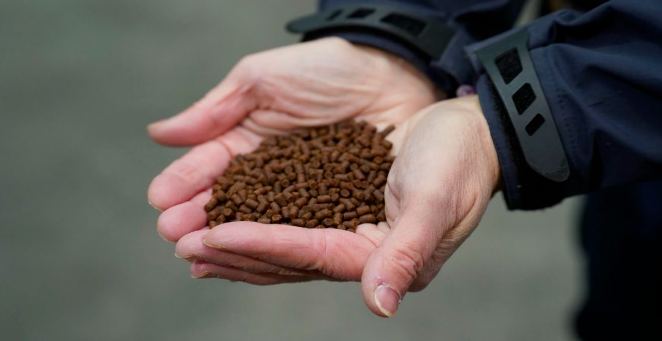
Most conversations about salmon farming skip straight past the feed. That is a mistake, because the feed answers a lot of the questions people actually have. Is it sustainable? Is it Canadian? Does it make sense as a way to produce food? Pull the feed apart and look at it, and the case for keeping salmon farming in Canada gets stronger, not weaker.
Here is the short version. B.C. farm-raised salmon feed is made in British Columbia, mostly from ingredients grown and processed in Canada. It is efficient enough that the fish now produce more marine protein than they consume. And it carries a lower carbon footprint than the feed used by the countries that would supply Canada's salmon if the Trudeau-era 2029 net-pen ban goes ahead.
That is a real Canadian advantage, and it is worth understanding before any decision is made about the future of the sector.
A pellet, mostly made of plants
Salmon are omnivores. In the wild they eat a mix of plants and animals, and they need both to grow. Farm-raised salmon are no different, so their feed has to deliver balanced nutrition from both sources.
It comes as an extruded pellet, sized and formulated for the fish's life stage. A typical B.C. Atlantic salmon feed runs roughly 30 to 45 percent alternative proteins such as plants and poultry, 12 to 20 percent alternative oils such as canola and flax, 10 to 15 percent binders and carbohydrates, and the remainder a mix of fish meal, fish oil, and micronutrients. Fish meal and fish oil, once the backbone of salmon feed, now make up a minority of it. Some B.C. formulas have brought fish meal down to roughly 15 percent and fish oil to around 11 percent, and a few go lower still.
There are no added steroids or hormones. The pink colour comes from astaxanthin, a natural pigment and antioxidant that wild salmon also get from their diet of krill and other small marine animals.
Made in B.C., sourced close to home
Every salmon feed used in British Columbia is manufactured in the province. Cargill Aqua Nutrition and Skretting produce Atlantic salmon feed in Surrey and Vancouver. Taplow Feeds in Chilliwack supplies Chinook salmon and other species.
B.C. feed companies estimate that, on average, about 80 percent of the raw material in Atlantic salmon feed comes from Canada and the United States. The plant proteins are crops such as wheat, corn gluten, and sunflower. The oils are mostly canola and flax. The fish trimmings used in B.C. all come from sustainably managed Alaskan pollock and Pacific hake fisheries landed in Canada and the U.S.
That is a domestic supply chain. Feed mills in three B.C. towns, ingredients from North American farms and fisheries, formulated for fish grown in Canadian waters. The jobs, the contracts, and the money stay here.
More protein out than in
For years the sharpest criticism of salmon farming was that it took more fish out of the ocean than it put back on the plate. That was a fair concern once. It no longer holds.
B.C. farm-raised Atlantic salmon need about 1.15 to 1.2 kilograms of feed, all ingredients combined, to gain a kilogram of body mass. Compare that to chicken, pork, or beef and salmon comes out well ahead. Because so much of the fish meal and oil now comes from trimmings and by-products of fisheries managed for human consumption, rather than from fish caught specifically for feed, farm-raised Atlantic salmon have become net producers of marine protein. They generate more than they consume.
Using trimmings matters for another reason. The parts of a pollock or a hake that people do not eat would otherwise be waste. Routing them into salmon feed puts the whole fish to use.
A lower-carbon advantage, made in Canada
This is where the made-in-B.C. feed earns its place.
Feed produced by Skretting in Canada has a measured carbon footprint of about 1.6 kilograms of CO2 equivalent per kilogram of feed. The same company's feed produced in Norway comes in around 2.2. In Chile, about 2.4. The Canadian feed is cleaner because the ingredients are sourced locally, which strips transportation and land-use emissions out of the total.
Norway, Chile, and Scotland are the countries that would fill Canadian grocery shelves if domestic production shuts down. Their salmon is raised on higher-carbon feed and then flown thousands of kilometres to reach Canada. Keeping salmon farming in Canada keeps the lower-carbon option, the one already operating in Canadian waters on Canadian-made feed, on Canadian shelves. That lines up with the environmental goals Canada has set for itself.
Farm-raised salmon already has the lowest average carbon footprint of any major animal protein per serving, lower than chicken, pork, or beef. Reversing the ban keeps that advantage working for Canada.
A sector that ranks first on sustainability
The two international companies that operate most of B.C.'s Atlantic salmon farms, MOWI and Grieg Seafood (now owned by Cermaq Canada), ranked first and second on the 2021 Coller FAIRR Protein Producer Index. That index assessed 60 of the world's largest protein producers across meat, dairy, and aquaculture on ten environmental, social, and governance measures. Seven of the top ten were aquaculture companies. Salmon farming companies outperformed land-animal protein producers on every risk factor, with the widest margins on deforestation, biodiversity, and antibiotics.
On top of that, every Atlantic salmon farm in B.C. holds Best Aquaculture Practices (BAP) certification, which sets standards for the feed mills themselves. Many farms are also certified by the Aquaculture Stewardship Council (ASC), whose feed standard requires that every ingredient above one percent of the formula be traceable and responsibly sourced.
This is a sector measured against the toughest benchmarks available, and it scores at the top.
The practical choice
The feed question turns out to be a Canada question. B.C. salmon feed is made by Canadian workers, from mostly Canadian and American ingredients, for fish grown in Canadian waters, and it does the job more efficiently and with a lower carbon footprint than the imported alternative.
Reversing the Trudeau-era 2029 net-pen ban keeps that supply chain in Canada. It protects feed-mill jobs in Surrey, Vancouver, and Chilliwack, supports the farms and fisheries that supply the ingredients, and keeps a lower-carbon source of protein on Canadian shelves. It is a step the government can take within its own control, and it lines up with affordability, food security, and the environmental goals Canada has already set.
Canada can grow more of its own food, and feed it with ingredients grown close to home. The investment is ready. The only thing in the way is federal policy.
References
(1) B.C. Salmon Farmers Association. (2024). Modern Salmon Farming in B.C.: A Review, Chapter 7: Feed Sustainability, p. 7-1 to 7-18.
(2) Skretting. (2022). Sustainability Report. As cited in Chapter 7, p. 7-15 to 7-16.
(3) Global Salmon Initiative. (2022). Sustainability Report. As cited in Chapter 7, p. 7-16.
(4) FAIRR Initiative. (2023). Coller FAIRR Protein Producer Index. As cited in Chapter 7, p. 7-15.
(5) Aquaculture Stewardship Council. (2024). ASC Feed Standard. As cited in Chapter 7, p. 7-18.
(6) Best Aquaculture Practices. (2024). BAP Certification Standards. As cited in Chapter 7, p. 7-17.
(7) B.C. Salmon Farmers Association. (2024). FAQ: Economic Impacts of B.C. Salmon Farming.
Frequently asked
What is in farm-raised salmon feed?
B.C. Atlantic salmon feed is an extruded pellet made mostly of plant and land-animal proteins and oils, with a smaller share of fish meal and fish oil. It contains no added steroids or hormones.
Is salmon feed made in Canada?
Yes. All salmon feed used in B.C. is manufactured in the province, in Surrey, Vancouver, and Chilliwack, with about 80 percent of ingredients sourced from Canada and the United States.
Coalition of First Nations for Finfish Stewardship