
Open Letter to Tony Allard: You Keep Speaking About Us. Why Won't You Speak With Us?
Rightsholder coastal First Nations respond to Tony Allard's call for the federal government to uphold its 2029 salmon farming ban, and invite him to their territories for respectful, evidence-based dialogue.
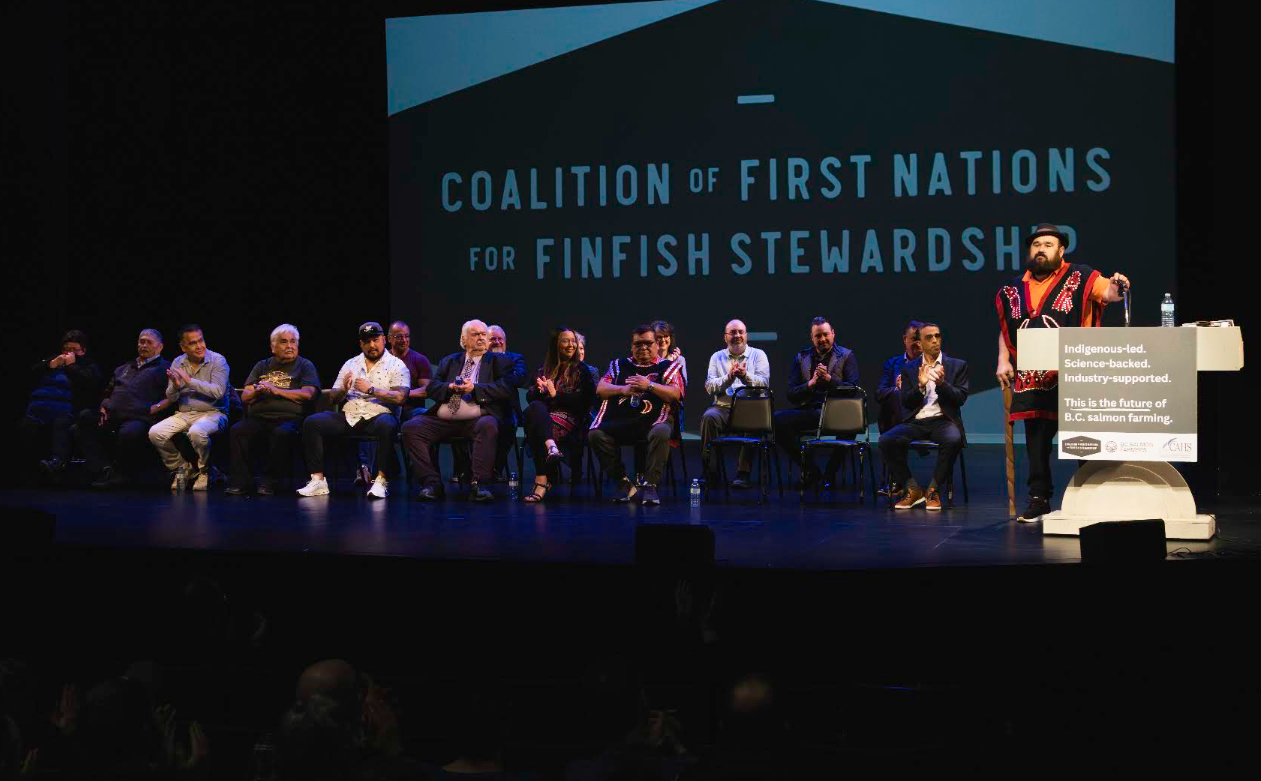
Response to Tony Allard opinion piece published July 14, 2026, in National Newswatch
For nearly a decade, Tony Allard has used his personal wealth-funded platform to incite unfounded fear about the effects of salmon farming on wild Pacific salmon. His most recent opinion piece, directed to Prime Minister Carney, repeats his call for the federal government to uphold the planned removal of open-net pen salmon farms from British Columbia by 2029.
Mr. Allard argues that the wild Pacific salmon economy supports thousands of jobs and contributes to the culture and food security of coastal First Nations. We agree that wild salmon are fundamental to the cultures, identities, food systems and economies of First Nations throughout British Columbia. Where we disagree is with the suggestion that protecting wild salmon requires the federal government to eliminate salmon aquaculture from the territories of Nations that have chosen to participate in it. The hypocrisy of Mr. Allard's stance is that he is promoting a wild salmon economy that increases the harvest of wild stocks that are already under immense pressures from overfishing—to save wild salmon, we need to kill more wild salmon, according to Mr. Allard.
For our Nations, salmon aquaculture is also contributing to employment, food security, community revenues and economic self-determination. It supports families within our communities, as well as thousands of workers and businesses across British Columbia and Canada.
We also dispute the article's characterization of the available science as settled. Mr. Allard's own argument illustrates the need for a more consistent approach to evidence. He characterizes Fisheries and Oceans Canada as "usually indistinguishable from the fish farming industry," yet immediately relies on DFO findings to support his claim of harm—manipulating the department's science when it supports his position while dismissing its credibility more broadly.
Our Nations commissioned a comprehensive review of aquaculture science from British Columbia salmon producers in 2024. The work took nearly a year and drew upon datasets from Fisheries and Oceans Canada, the Province of British Columbia, independent and international scientists, veterinary professionals and First Nations. As well as being published online, the review was directly provided at no cost to every one of the First Nations listed on Wild First's website as being opposed to salmon farming, as well as to organizations including Wild First, together with contact information and an invitation for further discussion.
That invitation has not yet resulted in meaningful dialogue with Mr. Allard or many of the organizations and Nations cited as opposing salmon farming.
Constructive dialogue requires more than competing opinion pieces. It requires a willingness to examine evidence, listen to the Nations directly affected and recognize that First Nations do not hold a single position on aquaculture, or frankly, on the management of any natural resource. This is a colonial approach that First Nations must deal with on a constant basis.
Our Nations play a direct role in governing salmon farming within our territories, including establishing expectations that often exceed federal requirements. We conduct and participate in monitoring related to sea lice, ocean temperatures, waste management, fish health and interactions with other marine species. This work reflects Indigenous-led stewardship and Indigenous-led science.
Wild salmon are inseparable from our cultures and responsibilities to future generations. Our Nations would not support activities that we believed presented an unacceptable risk to the salmon, waters and ecosystems we are responsible for protecting. At the same time, stewardship does not require rejecting every form of economic activity. It requires careful governance, continual learning, accountability and the authority to make informed decisions within our own territories.
Mr. Allard's article states that 130 First Nations support ending open-net pen salmon farming. That claim should not be used to speak over the rightsholder Nations in whose territories the farms are located. We trust those 130 First Nations to manage their territories when it comes to forestry operations, pipeline projects, critical mineral mining and dozens of other economic pursuits. It is illogical to support resource development and economic self-determination for some First Nations while denying those same principles to Nations that choose salmon aquaculture.
Prime Minister Carney has outlined an economic agenda centred on affordability, food security, investment and economic reconciliation. Rightsholder Nations believe that responsibly managed, modern salmon aquaculture can contribute to each of those priorities. We remain ready to work with Canada, industry, scientists and other First Nations to improve technology, strengthen oversight and protect both wild salmon and coastal livelihoods.
Mr. Allard, the invitation to visit our territories and participate in respectful, evidence-based dialogue remains open. We encourage you to accept it.
Frequently asked
Do coastal First Nations support salmon farming in British Columbia?
First Nations do not hold a single position on aquaculture. Rightsholder Nations in whose territories the farms operate have chosen to participate in salmon farming because it supports employment, food security, community revenues and economic self-determination.
What is the federal government's 2029 salmon farming ban?
It is the federal plan to remove open-net pen salmon farms from British Columbia by 2029. Rightsholder Nations argue the policy eliminates aquaculture from territories where Nations have chosen to participate in it.
Who is Tony Allard and what did he write?
Tony Allard funds a platform opposing salmon farming and published an opinion piece on July 14, 2026, directed to Prime Minister Carney, calling for the federal government to uphold the 2029 removal of open-net pen salmon farms.
Coalition of First Nations for Finfish Stewardship