
B.C. Salmon Farming - Indigenous Guardians and the Oversight Already on the Water
Indigenous Guardians already monitor every B.C. salmon farm in partnership with First Nations. The federal government's 2029 salmon farming ban would dismantle that on-the-water oversight along with the farms.
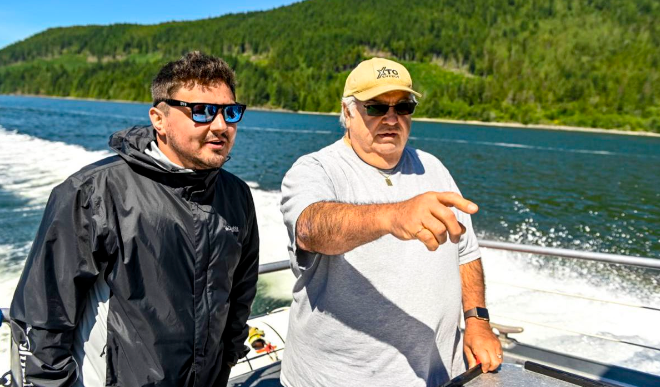
Indigenous Guardian Watchmen are the day-to-day expression of First Nations' inherent right to manage their own territories. Guardians from First Nations who host salmon farms in their waters sample juvenile wild salmon near the pens, take water quality and sediment readings, monitor kelp beds, eelgrass meadows, and glass sponge reefs, and review every stage of a farm's operation throughout its working life. The Trudeau-era 2029 net-pen salmon farming ban would close down this oversight infrastructure at the moment Canada needs it most.
What Guardians actually do on a salmon farm
A Guardian program is a Nation's eyes and ears on its own territory. In remote, coastal communities where salmon farming operates, that responsibility has translated into a concrete set of duties carried out year-round. Guardians monitor the day-to-day work of salmon farmers and their contractors. They conduct juvenile wild salmon sampling in the waters around farm sites and survey nearby ecosystems for the health of sensitive species such as kelp beds, eelgrass, and glass sponge reefs. They establish environmental baseline data at potential new sites using remotely operated vehicles, identify suitable marine locations based on surveys and traditional knowledge of local conditions, and ensure that cultural and archaeological sites are mapped and protected. When a farm is removed from a territory, Guardians assist with the careful decommissioning of the site.
This is continuous, on-the-water presence by people from the territory itself, combining traditional knowledge of the area with the technical training to collect data that meets a high regulatory standard.
Traditional knowledge and Western science, working together
Coastal First Nations have been studying, observing, and navigating their lands and waters for more than 10,000 years. Knowledge of wild salmon migration routes, feeding patterns, and the seasonal behaviour of a specific inlet has been passed down through generations. Traditional Ecological Knowledge (TEK) of that depth cannot be substituted by a survey or a satellite feed.
What has changed in recent decades is the recognition that this knowledge belongs at the centre of marine management. Guardian programs combine inherited knowledge with the tools of Western science: environmental DNA sampling, water quality testing, ROV surveys, ecosystem monitoring protocols. Each method tells the other something it cannot see alone. Braiding the two produces a more complete picture of a coastal environment than either could deliver by itself.
The BC Centre for Aquatic Health Sciences (BC CAHS) in Campbell River, an ISO-accredited laboratory, has modernized its governance to be Indigenous-led. Now the Indigenous Centre for Aquatic Health Sciences (ICAHS), this facility is a shared place where Nations can bring samples, apply their knowledge, run diagnostic work, and direct research priorities tied to wild salmon and marine protection. Organizations such as ICAHS work alongside Guardian programs to build long-term science capacity within the Nations themselves.
How the ban removes the watchers along with the watched
Guardian programs in salmon farming territories are funded, in significant part, by the partnerships that produced them. Impact-benefit agreements between First Nations and salmon farming companies typically fund environmental monitoring and oversight conducted by Nation Guardians. The revenue, the training pipeline, and the on-water infrastructure that make this work possible are tied to the existence of the farms themselves.
100% of salmon farmed in B.C. is raised in partnership with First Nations. That partnership is the foundation that First Nation Guardian oversight stands on. If the federal government's 2029 ban proceeds, the partnerships dissolve and the funding dries up. The waters still need watching. The Nations still hold the responsibility for their territories. What disappears is the people, the boats, and the resources to do the work.
A model worth keeping in place
Indigenous oversight of salmon farming on the B.C. coast is a working example of what the federal government has committed to elsewhere on paper: implementing the United Nations Declaration on the Rights of Indigenous Peoples, supporting Indigenous management of fisheries and fish habitats, and recognizing First Nations' authority over their own marine spaces. Guardian programs do this every day, and they do it in partnership with a sector that helps pay for the capacity to keep doing it.
Reversing the ban keeps the boats on the water, the data flowing, and the people who have stewarded these waters since time immemorial in charge of what happens in them.
That is what oversight looks like when it belongs to the people of the place.
References
- BC Salmon Farmers Association. 2024. Caring for Indigenous Stewardship — Connecting with the Original Guardians of the Coast. Chapter 4 in Modern Salmon Farming in BC: A Review. Campbell River, British Columbia.
- BC Salmon Farmers Association. 2024. Caring for Wild Salmon — The Local Picture. Chapter 3 in Modern Salmon Farming in BC: A Review. Campbell River, British Columbia.
- BC Centre for Aquatic Health Sciences (BC CAHS), Campbell River, B.C.
- Government of Canada. 2023. United Nations Declaration Act Action Plan.
- BC Centre for Aquatic Health Sciences. Evolving to the Indigenous Centre for Aquatic Health Sciences Stewardship. June 17, 2026.
Frequently asked
What is a Guardian Watchman program?
Guardian Watchman programs are on-the-water stewardship teams run by First Nations to monitor and manage activity within their traditional territories year-round. In salmon farming territories on the B.C. coast, Guardians work alongside companies to sample wild salmon, test water quality, survey ecosystems, and oversee the day-to-day operations of the farms.
How do Indigenous Guardians oversee salmon farms in British Columbia?
Guardians conduct juvenile wild salmon sampling near farm sites, collect water and biological samples, survey sensitive ecosystems such as kelp beds and glass sponge reefs, establish baseline data using remotely operated vehicles, and ensure cultural and archaeological sites are identified and protected. They also assist with the careful decommissioning of any farms removed from a territory.
What is ICAHS?
ICAHS is the Indigenous Centre for Aquatic Health Sciences, the renamed and Indigenous-led successor to the BC Centre for Aquatic Health Sciences (BC CAHS) in Campbell River. It is an ISO-accredited laboratory where coastal First Nations can bring samples, run diagnostic work, and direct research priorities tied to wild salmon and marine protection.
Coalition of First Nations for Finfish Stewardship