
B.C. Farmed Salmon Escapes Reduced by 97%. Ottawa Should Not Ignore That Progress.
Escapes from B.C. salmon farms have dropped 97% since 2010. Here is how containment works, and why the federal government's 2029 salmon farming ban risks discarding proven progress.
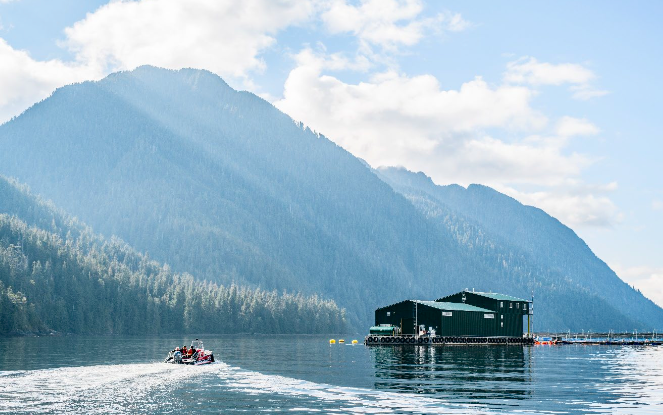
Ask anyone with a long memory of the B.C. coast about salmon farming, and the word that often comes up is escapes. It is a fair concern, and one First Nation farmers take seriously. Coastal First Nations have stewarded wild salmon for thousands of years, and keeping farm-raised salmon contained and separate from wild stocks is part of that responsibility.
Here is the number that matters most.
Escapes from B.C. salmon farms have fallen by 97% since 2010.
That is not a projection or a goal. It is what the record shows, drawn from escape reports that B.C. salmon farms are required to file with Fisheries and Oceans Canada. The system works because it was redesigned to work.
What containment looks like in 2026
A modern net-pen is engineered equipment. Fisheries and Oceans Canada require every containment system to withstand the local weather and ocean conditions of the site it sits on. Those systems are inspected and maintained on a schedule, with attention to the things that historically caused failures: biological buildup on the nets, ice, and damage from marine mammals.
The day-to-day work happens at the farm. Every crew member is trained to spot the early signs that a fish may have left containment. A sudden drop in the feed rate in one pen is a signal. So is a hole in either the containment net or the predator net large enough for a fish to pass through. So is the sight of a farm-raised salmon outside the pen.
When any of those signs appear, staff inspect the nets with underwater cameras, walk the site, and check whether a handling error has occurred. If a hole is found, a repair kit is deployed, the hole is covered and patched on the spot, and a diver inspects the repair. The goal the sector works toward is plain: zero escapes.
The regulatory framework around it
Containment is not left to the farms alone. When an escape does happen, the response is set by licence conditions, by the protocols and agreements of the First Nation whose territory the farm sits in, and by certification requirements.
Relevant authorities are notified within 24 hours. Every event is investigated, and a report goes to regulators within seven days. Fisheries and Oceans Canada then publishes detailed escape reports for B.C. aquaculture sites. The data behind the 97% figure is public, and it is public because reporting is mandatory.
What the record actually shows
The developmental years of the industry, from 1991 to 2010, were a different era. Roughly 660,000 Atlantic salmon escaped from B.C. marine net-pens over those two decades, most often through infrastructure failure, human error, and weather. Containment technology had not yet caught up to the job.
By 2010 it had. From 2011 to 2018, adult Atlantic salmon escapes from B.C. net-pens averaged 12 fish a year. From 2020 to 2022, the total across all three years was 121 fish.
Pacific salmon farms tell the same story. Since 2012, only one Chinook salmon has escaped from a B.C. farm in the 2020 to 2022 period. For scale, public hatcheries in B.C. released more than 411 million Pacific salmon into the same waters in 2020 and 2021 alone.
The exception is 2019, when a fire at a B.C. farm allowed roughly 21,000 Atlantic salmon to escape in a single event. It belongs in any honest account. It was also a single, identifiable incident in a stretch of years that otherwise produced almost no escapes, and the long-run trend was not reversed by it.
Why escaped Atlantic salmon do not establish
There is a second layer to this question, and it is the one a century of B.C. history settles. Even when Atlantic salmon have entered B.C. waters, they have not established self-sustaining populations.
This is not for lack of trying. Between 1905 and 1935, B.C. was the site of one of the most intensive Atlantic salmon introduction programs anywhere in the world. Nearly 200 deliberate attempts placed close to 14 million eggs and young fish into 52 lakes and rivers across the province. Across B.C. and the United States together, more than 370 deliberate efforts to establish Atlantic salmon failed.
The reasons sit in the biology of the fish. Atlantic salmon have a narrow tolerance for habitat conditions and are weak competitors against other species. Farm-raised fish are reared on salmon feed, and therefore rarely manage to find food in the wild after escaping. The Atlantic Salmon Watch Program, running since 1991, has found no evidence of an established Atlantic salmon population anywhere in B.C.
A self-sustaining run would require escaped fish to survive in numbers, find mates, spawn, and have their offspring complete the full freshwater and saltwater migration cycle, again and again. A century of evidence says Atlantic salmon cannot accomplish this in B.C.
What this means for the 2029 ban
Put the two findings together. Containment has improved to the point where escapes are rare, and the biology means a rare escape is very unlikely to establish a wild population. The system that was a genuine weakness in the 1990s has become one of the sector's documented strengths.
The Trudeau-era 2029 net-pen ban would close that system down. It would not improve containment, because containment is already performing and improving. It would remove the farms, the trained crews, the inspection routines, and the public reporting that produced the 97% result. The risk the ban points to is a risk the sector has already spent fifteen years managing down.
Canada gains nothing on wild salmon protection by ending B.C. salmon farming. It loses Canadian-grown salmon supply, coastal jobs, and First Nations-led economic participation, and it loses a containment record that demonstrates this food can be produced responsibly. Reversing the ban keeps that production in Canada and keeps the people who built the modern containment system doing the work they have shown they can do well.
The position of First Nations who host salmon farms in their territories is straightforward. The concern about escapes was real, the sector acted on it, and the record proves the action worked. A policy that ignores that record is not protecting wild salmon. It is discarding a Canadian food source that has already earned the trust the ban assumes it lacks.
References
- BC Salmon Farmers Association. 2024. Caring for wild salmon: Preventing escapes. In Modern Salmon Farming in BC: A Review. Campbell River, B.C.
- BC Salmon Farmers Association. Fish Escapes FAQ. Available at bcsalmonfarmers.ca/faq
- Fisheries and Oceans Canada. Escapes of cultured finfish from B.C. aquaculture sites. Government of Canada open data.
- Fisheries and Oceans Canada. 2018. Wild fish predation project.
- Fisheries and Oceans Canada. 2023. Marine finfish B.C. aquaculture licence and conditions of licence. Nanaimo, B.C.
- Andres, B. 2015. Summary of reported Atlantic salmon catches and sightings in British Columbia and results of field work conducted in 2011 and 2012. Fisheries and Oceans Canada, Campbell River, B.C.
Frequently asked
How much have salmon escapes decreased from B.C. farms?
Escapes from B.C. salmon farms have fallen by 97% since 2010. From 2011 to 2018, adult Atlantic salmon escapes averaged 12 fish per year, and from 2020 to 2022 the total across all three years was 121 fish.
Can escaped Atlantic salmon establish wild populations in British Columbia?
No. Between 1905 and 1935, nearly 200 deliberate attempts to introduce Atlantic salmon into B.C. waters failed. The Atlantic Salmon Watch Program, running since 1991, has found no evidence of an established Atlantic salmon population anywhere in B.C.
What containment measures do B.C. salmon farms use to prevent escapes?
B.C. salmon farms use engineered net-pen systems built to withstand local ocean and weather conditions, trained crews who monitor for signs of containment failure, underwater camera inspections, on-site dive repairs, and mandatory 24-hour reporting to Fisheries and Oceans Canada when an escape occurs.
Coalition of First Nations for Finfish Stewardship