
B.C. Salmon Farming - The Careers That Keep Families on the Coast
Salmon farming offers year-round careers that keep coastal families in the communities they call home. Reversing the federal government's 2029 salmon farming ban protects the jobs those communities depend on.
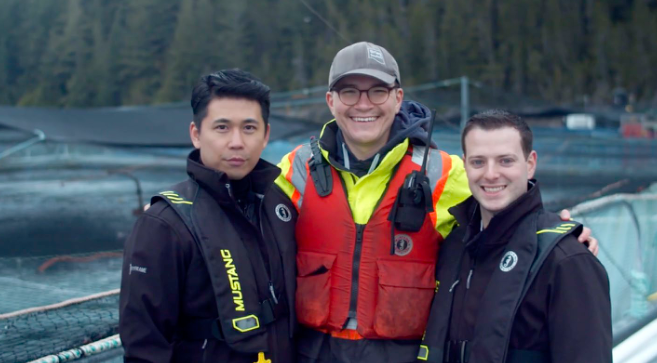
In a lot of small coastal towns, the hardest part of growing up is having to leave. The good jobs are somewhere else, usually a ferry ride and a city away, and every young person who goes after one is a person the community does not get back. Salmon farming has quietly become one of the few sectors that reverses that pull. It offers careers that let people build a life in the place they are from.
These are year-round jobs, not seasonal shifts that vanish when the weather turns. The average wage across the sector runs about 30% higher than the provincial median employment income, and the work tends to land exactly where it is needed most, in regions of higher unemployment along North Vancouver Island and up the coast to communities such as Klemtu on the central coast. In towns with very few alternative employers, that combination of stable hours and a real paycheque is the difference between staying and going.
What gets less attention is how far a career in aquaculture can travel. Someone can start on a feed barge or a harvest crew and move into fish health, dive operations, site management, or the technical and environmental roles the modern sector runs on. The path is real, and the sector has purposefully built training into it. The Young Salmon Farmers of B.C. mentor youth through community projects, beach clean-ups, and eelgrass restoration work, giving people their first foothold. Farther along, companies partner with North Island College and Vancouver Island University, including their culinary programs, so the next generation learns where their food comes from and how it is grown.
Then there is the work the farms create without ever putting anyone on a net pen. Every farm needs electricians, mechanics, plumbers, net lofts, marine services, fabricators, boat builders, and the trucking and logistics outfits that keep it all moving. Local grocery stores, fuel distributors, and engineering firms feel it too. The first dollar a farm spends is often spent close to home, and it keeps circulating. That ripple is how a single sector ends up supporting careers across a whole town, and it is why salmon farming sustains roughly 4,500 jobs across the country in annual terms, concentrated in remote Indigenous and coastal communities.
That last point matters more than a job count reveals. 100% of salmon farmed in B.C. is raised in partnership with First Nations. For many coastal First Nations, these careers mean members trained, employed, and advancing within their own territories, on the water their families have always known. Keeping that economic base intact is reconciliation that shows up in a paycheque.
All of this is exactly what policy uncertainty puts at risk. The sector contraction that began in 2019 has already pulled thousands of jobs out of these communities, and a career is not something you can pause and pick back up. A young worker who leaves for the mainland to find steady work rarely comes back. The skills walk out the door with them, and the training pipeline that took years to build starts to thin. The federal government's 2029 salmon farming ban deepens that uncertainty at precisely the moment these communities can least afford it.
The good news is that the fix is just as concrete as the damage. Reversing the Trudeau-era 2029 net-pen ban gives families a reason to stay, gives young people a career worth training for, and gives coastal communities the investment certainty they need to keep growing their own. The sector itself has said the future could hold substantial career opportunities with that certainty restored.
Coastal B.C. does not need to export its young people to thrive. It needs the jobs that let them stay.
References
- BC Salmon Farmers Association. 2024. Caring for Communities - Salmon Aquaculture in Coastal Communities, in Modern Salmon Farming in BC: A Review. BC Salmon Farmers Association, Campbell River, British Columbia.
- BC Salmon Farmers Association. Economic Impact (FAQ). Modern Salmon Farming: A Review.
- Collins B, McCannel J. Aquaculture on Vancouver Island. Prepared for the Vancouver Island Economic Alliance. Nanaimo, BC; 2019.
Frequently asked
How many jobs does B.C. salmon farming support?
Salmon farming sustains roughly 4,500 jobs across the country in annual terms, concentrated in remote Indigenous and coastal communities where alternative employment is scarce.
Do salmon farming jobs pay well?
The average wage across the sector runs about 30% higher than the provincial median employment income, and the jobs are year-round rather than seasonal.
How does the 2029 salmon farming ban affect coastal communities?
The sector contraction that began in 2019 has already pulled thousands of jobs out of these communities. Reversing the ban restores the investment certainty needed to keep training and hiring locally.
Coalition of First Nations for Finfish Stewardship