
BC Salmon Farming Facts - Bycatch and Incidental Catch: The Numbers on the Record
B.C. salmon farms recorded 1.5 million incidental catch mortalities from 2011 to 2022, 94.4% Pacific herring, all publicly reported. Reversing the federal government's 2029 salmon farming ban keeps that record open.
Incidental catch at B.C. salmon farms is one of the most carefully tracked datasets in Canadian aquaculture. Every wild fish caught at a farm, released alive or recorded as a mortality, is reported to Fisheries and Oceans Canada (DFO) by species and by number. DFO publishes the figures on an open government data portal. The numbers are not estimates. They are counted, audited and publicly posted.
That makes this an unusual policy debate. The data exist, in detail, going back more than a decade. The federal government's 2029 salmon farming ban is being applied to a sector whose environmental footprint is more transparently documented than almost any other food production system on the coast.
Here is what the public record shows.
What incidental catch is, and why it happens
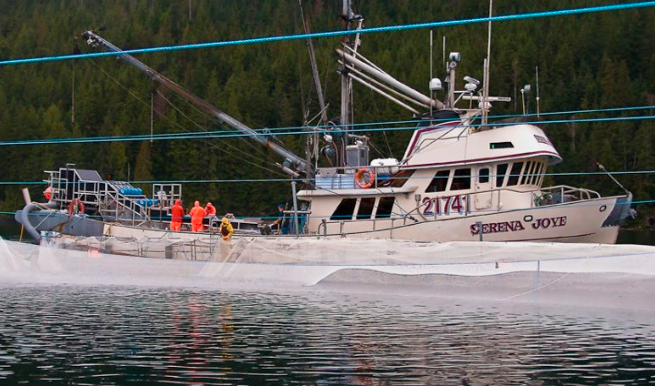
Incidental catch refers to any wild finfish that ends up inside the nets of a salmon farm. Wild fish swim through the netting as juveniles, find shelter among the farmed salmon, and in some cases grow too large to swim back out. Most are released alive during routine net handling and harvest operations. Some do not survive the handling, and those mortalities are what farmers are required to report.
DFO set the licence conditions. Farmers design equipment to minimize harm, train staff to identify species correctly, and run mandatory release protocols. The same rules apply across every farm site in B.C.
The twelve-year record: 2011 to 2022
From 2011 to 2022, B.C. salmon farms recorded 1,520,457 incidental catch mortalities in total. Of that figure, 94.4% were Pacific herring, primarily juveniles. The remaining 5.6% covers groundfish, rockfish, sablefish, other pelagic species, and Pacific salmon.
The herring number sounds large in isolation. In context, it represents 0.014% of the commercial herring fishery catch over the same period, excluding the roe, food, bait, and special-use fisheries. The largest single year for herring incidental catch was 2022 in Clayoquot Sound. That same year, the West Coast of Vancouver Island recorded its largest herring spawn event since 2013, and salmon farm herring mortality across all areas combined was equivalent to 0.086% of the WCVI spawning biomass.
The non-herring categories are smaller still:
- Rockfish: 21,732 fish over twelve years, approximately 3.26 tonnes. That is 0.5% of the rockfish bycatch associated with B.C. commercial and recreational capture fisheries between 1996 and 2011, as estimated by Living Oceans Society.
- Sablefish: 7,015 fish over twelve years, averaging 0.95 tonnes annually. That is 0.04% of the 2,246 tonnes landed by the commercial sablefish fishery in 2022 alone.
- Other pelagic fish (pollock, anchovy and similar species, excluding herring, salmon, and eulachon): 7,801 fish over twelve years. With an average of 73 farms operating at any one time, that works out to fewer than nine fish per farm per year.
- Eulachon: a single individual reported across the entire twelve-year window.
For perspective on the totals, excluding herring, B.C. salmon farms average about 97 wild fish mortalities per farm per year. That is fewer than two wild fish per farm per week.
Pacific salmon: the question people ask most
Wild Pacific salmon incidental catch at B.C. farms totalled 402 fish over the eleven years from 2011 to 2021. Almost all weighed under 500 grams. Over that same period, B.C. commercial and recreational capture fisheries landed 73,694,320 wild Pacific salmon.
That ratio matters. For every wild Pacific salmon counted as incidental catch at a B.C. farm, capture fisheries landed roughly 183,000.
How farmers have driven the numbers down
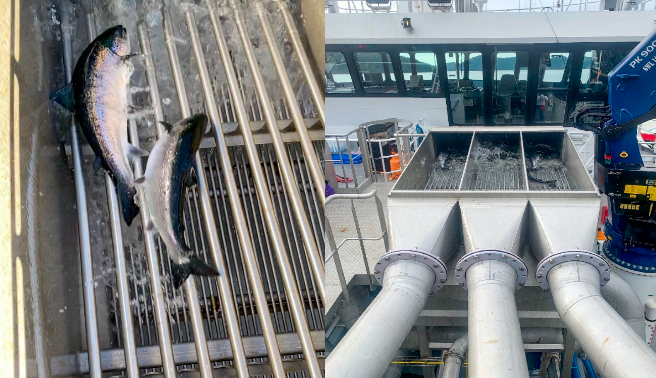
The figures above reflect more than a decade of operational changes. Salmon farmers switched from metal halide lighting to LED systems around ten years ago to reduce wild fish attraction at night. Vessels use grader bar systems calibrated to the size of the farmed fish, so smaller wild fish pass through to a sorting table and back to the water rather than into the next pen. Staff are trained in species identification and required to record every release.
The result is a long-term decline in interactions and a public record sharp enough to be checked by anyone with an internet connection.
Keeping the record on Canadian books
The Trudeau-era 2029 net-pen ban applies to the sector responsible for the most detailed incidental catch data on the B.C. coast. Reversing the federal government's 2029 salmon farming ban preserves that data ledger and the operational standards driving those numbers lower each year.
Aquaculture imports already account for more than $700 million annually in Norwegian, Chilean, and Scottish salmon entering Canada. Those production systems carry their own incidental catch footprint, reported under regimes set outside Canada. Replacing 56,000 tonnes of B.C. production with additional imports relocates the environmental ledger offshore.
Honest accounting only works when there is a sector left to do the accounting.
References
- Modern Salmon Farming in B.C.: A Review, Chapter 6 — Minimizing Incidental Catch.
- Fisheries and Oceans Canada. Incidental catch at B.C. marine finfish aquaculture sites. Government of Canada Open Data Portal.
- Fisheries and Oceans Canada. Stock Status Update with Application of Management Procedures for Pacific Herring in B.C.: Status in 2022 and Forecast for 2023.
- North Pacific Anadromous Fish Commission Statistics.
- Living Oceans Society, rockfish bycatch estimates, B.C. commercial and recreational fisheries, 1996-2011.
- BCSFA FAQ: Bycatch and Incidental Catch (v.04).
Frequently asked
How many wild fish are caught at B.C. salmon farms?
From 2011 to 2022, B.C. salmon farms recorded 1,520,457 incidental catch mortalities, with 94.4% being Pacific herring. Excluding herring, that averages fewer than two wild fish mortalities per farm per week. All figures are reported to Fisheries and Oceans Canada by species and number, and published on an open government data portal.
How many wild Pacific salmon are caught at B.C. salmon farms?
From 2011 to 2021, 402 wild Pacific salmon were recorded as incidental catch mortalities at B.C. salmon farms. Almost all weighed under 500 grams. Over the same period, B.C. commercial and recreational capture fisheries landed 73,694,320 wild Pacific salmon.
Do salmon farms in B.C. have to report bycatch?
Yes. Under Fisheries and Oceans Canada licence conditions, B.C. salmon farms are required to report all wild fish releases and mortalities by species and number. DFO publishes the data on a public government website.
Coalition of First Nations for Finfish Stewardship