
B.C. Salmon Farming - The Supplier Network That Keeps Coastal Towns Working
More than 1,700 local businesses across coastal B.C. hold annual contracts with the salmon farming sector. The federal government's 2029 salmon farming ban puts that supplier chain at risk.
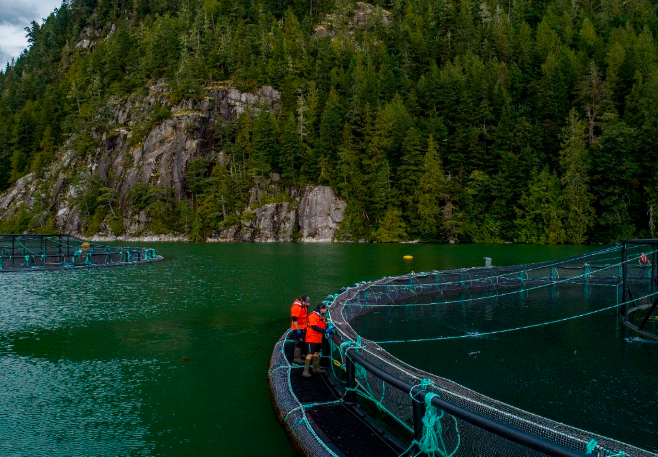
More than 1,700 local businesses across coastal B.C. supply the salmon farming sector, and together they receive over $500 million in annual contracts from farm operations. That spending circulates through fuel docks, machine shops, trucking lines, processing plants, and the dozens of trades that keep a working waterfront running. It is the part of the sector you do not see in the price of a fillet, and it is what the Trudeau-era 2029 net-pen ban puts at risk.
Who supplies a salmon farm
The supplier list reads like a small-town business directory. Marine chandlers and net lofts. Crew boat companies and barge operators. Fabricators, electricians, plumbers, mechanics. Fuel distributors, environmental services contractors, equipment rental yards. Engineering firms, IT providers, professional services. Cafes and grocery stores carrying the lunch business, and the hotels carrying the crew rotations. Each of these vendors holds its own payroll, and each of those paycheques lands back in the same small economy.
This is where the ripple effect lives. Every direct job on a salmon farm supports roughly one other job in the supplier chain. Fisheries and Oceans Canada and Statistics Canada both classify these as indirect and induced employment, and they are how a 4,500-job sector generates annual economic activity that ripples out well beyond the farm pens.
Where the vendor network concentrates
The regional numbers show how exposed some small towns are. The Campbell River region alone hosts close to 700 local salmon farming vendors, with annual local contracts of roughly $130 million. Port Hardy and Port McNeill together carry 145 local vendors and about $26 million in annual local spending. The Comox Valley adds 178 vendors and $27 million. The Sunshine Coast and Metro Vancouver corridor, where much of the feed manufacturing and equipment supply sits, runs to 447 vendors and almost $283 million in annual local contracts. Klemtu, on the central coast, anchors a smaller network in a community where the alternative employers can be counted on one hand.
The average wage in the sector is roughly 30% higher than the provincial median, and those paycheques land throughout regions where stable, year-round, middle-income work is hard to find. B.C. salmon farming remains the province's number-one seafood commodity export and its top agrifood export. It is also the rare modern food production sector where 100% of the farms in the province operate in partnership with First Nations, which means the supplier network includes a growing roster of Indigenous-owned marine services companies, transportation businesses, and construction trades working under those partnership agreements.
What happens when the anchor leaves
When an anchor employer leaves a small coastal town, the supplier chain does not transition. It contracts. The boat builder who serves three farm operators loses a third of his book of business and lays off a welder. The trucking company drops a route. The mechanic shop cuts a bay. The processing plant trims a shift, which means the cafe across the road trims one too. Policy uncertainty since 2019 has already started this process throughout coastal B.C., and the federal government's 2029 salmon farming ban completes it on the current timeline.
What reversing the ban protects
Reversing the ban keeps the supplier chain whole. It keeps the welders, the truckers, the marine service contractors, the engineering firms, and the food and accommodation businesses earning a year-round paycheque from the work they already know how to do. It keeps the local-vendor spending circulating where it lands now. And it does so without subsidy, without retraining schemes that have no destination, and without asking another sector to absorb the loss.
Every farm in B.C. carries a supplier chain behind it. Keep the farms running, and the towns built around them stay working.
References
- BC Salmon Farmers Association. 2024. Caring for Communities — Salmon Aquaculture in Coastal Communities, in Modern Salmon Farming in BC: A Review. Campbell River, B.C.
- RIAS Inc. 2020. Raising Opportunity: How Farm-Raised Salmon Can Lead BC's Post-COVID Recovery. Prepared for the BC Salmon Farmers Association.
- BC Salmon Farmers Association. Economic Impact FAQ. Available at bcsalmonfarmers.ca.
- Collins B, McCannel J. 2019. Aquaculture on Vancouver Island. Prepared for the Vancouver Island Economic Alliance.
Frequently asked
How many local businesses depend on B.C. salmon farming?
More than 1,700 local vendors across coastal B.C. hold contracts with the salmon farming sector, receiving over $500 million in annual spending from farm operations. These suppliers range from marine services and trucking to engineering firms, mechanics, and processing plants.
What kinds of businesses make up the B.C. salmon farming supplier network?
The supplier network covers trades and businesses such as fuel distribution, marine services, trucking and logistics, environmental services, seafood processing, fabrication, engineering, IT, equipment rentals, and the food and accommodation businesses that serve farm crews year-round.
What happens to coastal communities if the 2029 salmon farming ban proceeds?
The supplier chain contracts with the sector. Boat builders, mechanics, trucking companies, and processing plants tied to salmon farms lose a substantial share of their book of business, with the heaviest impact in towns such as Campbell River, Port Hardy, and Klemtu where alternative employers are limited.
Coalition of First Nations for Finfish Stewardship