
380 Million Meals. That Is What Canada Stands to Lose.
BC salmon farms produce enough protein for 380 million meals a year. The federal government's 2029 salmon farming ban does not make that food disappear. It just means it gets flown in from the other side of the planet.
BC salmon farms produce approximately 56,000 tonnes of farm-raised salmon every year. That is enough for roughly 380 million healthy, nutritious meals.
Eighty-five percent of the salmon harvested in British Columbia comes from farms. It is the province's top agri-food export. Health Canada, the American Heart Association, and Canada's Food Guide all recommend eating fish rich in omega-3 fatty acids regularly. Farm-raised salmon is one of the more accessible ways for Canadian families to follow that advice.
The 2029 net-pen salmon farming ban does not reduce demand for salmon. It eliminates Canadian supply.
Where the Replacement Comes From
When the ban removes 56,000 tonnes of domestic production, that volume is replaced by imports. In 2024, farmed salmon imports from countries Norway, Chile, and Scotland into Canada totaled over $700M. All three countries raise salmon in net pens.
The policy does not change how salmon is produced. It changes where it is produced and who benefits.
When production moves overseas, several things change.
The feed changes. Canadian salmon feed is manufactured locally in BC, with about 80 percent of ingredients sourced from Canada and the United States. The carbon footprint of Canadian-made feed is 1.6 kg CO2 equivalent per kilogram. In Norway, it is approximately 2.2. In Chile, approximately 2.4.
The transport changes. Instead of salmon moving from a BC farm to a BC processing facility to a Canadian grocery store, imported salmon crosses an ocean. Whether it is shipped or flown, that adds cost and carbon that did not exist when the fish was grown here.
The regulatory framework changes. Canadian salmon farms operate under federal and provincial food safety and environmental regulations. Farm-raised salmon in BC is regularly tested for antibiotics, pesticides, heavy metals, and other residues by the sector and by the Canadian Food Inspection Agency. Imported salmon is produced under another country's standards.
The economic benefit changes entirely. Instead of approximately $1 billion in economic activity staying in BC, that spending flows to foreign producers. Instead of 4,500 Canadian jobs, employment goes to workers in Norway, Chile, and Scotland. Instead of $51 million in annual direct economic benefit to First Nations communities, those communities receive nothing.
The Environmental Case for Canadian Production
Global food production accounts for about 30 percent of total greenhouse gas emissions. Roughly 70 percent of those emissions come from land-based agriculture and associated land use change.
Farm-raised salmon has the lowest average carbon footprint of any major animal protein. Per typical 40-gram serving, it produces fewer emissions than chicken, pork, or beef.
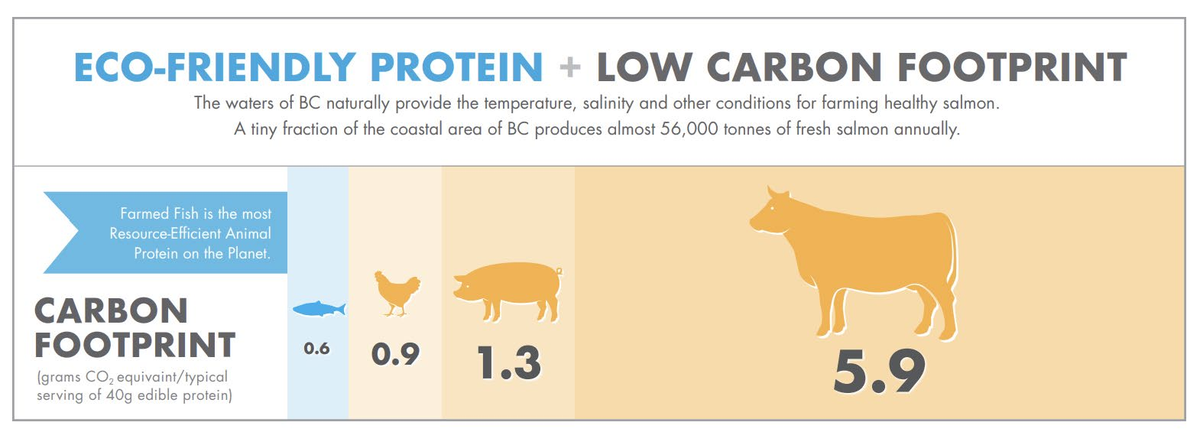
There are straightforward reasons for this. Fish do not require land conversion for pasture. They are cold-blooded and buoyant, so they convert feed into body mass more efficiently than warm-blooded animals. Less feed per kilogram of output means less water used to grow feed crops. Each of those efficiencies compounds into a smaller overall footprint.
But that footprint advantage depends partly on where the fish is raised. When salmon is flown from Norway to Vancouver instead of trucked from Campbell River, the carbon cost goes up at every stage.
The salmon farming ban takes one of the most resource-efficient food production systems in the world and makes it less efficient by adding transoceanic logistics.
Canada has committed to sustainable food systems and signed on to international agreements supporting responsible ocean-based food production. The 2029 ban works against those commitments by replacing local, lower-carbon food production with higher-carbon imports.
Food Security Is Not Abstract
Climate shocks. Trade disputes. Shipping disruptions. Tariff uncertainty. Canadians have seen all of these affect grocery prices in recent years.
A country that grows more of its own food has more options when global supply chains are disrupted. A country that depends on imports from three countries on different continents has fewer.
Domestic aquaculture is part of that resilience. It operates year-round, in Canadian waters, under Canadian regulation, staffed by Canadian workers, in partnership with First Nations who have stewarded these waters for thousands of years.
The 2029 salmon farming ban removes that domestic capacity and bets Canadian food supply on the assumption that international supply chains will always deliver. That is not a bet most Canadian families would choose to make.
380 Million Meals
That is what BC salmon farming produces every year. Enough to put Canadian-grown salmon on the table for millions of families, at a price shaped by domestic economics rather than international commodity markets.
The ban does not make those meals disappear. It makes them more expensive, more carbon-intensive, less secure, and entirely dependent on foreign supply.
Canada can grow more of its own food. The communities are ready. The investment is on the table. The science supports it.
The only thing standing in the way is federal policy.
References
(1) BC Salmon Farmers Association. (2024). Modern Salmon Farming in BC: A Review, Chapter 1: Caring for Coastal BC, p. 1-28.
(2) BC Salmon Farmers Association. (2024). Modern Salmon Farming in BC: A Review, Chapter 12: Food Safety, p. 12-2.
(3) Collins, B. & McCannel, J. (2019). Aquaculture on Vancouver Island. Vancouver Island Economic Alliance. [Ch13 ref 1]
(4) Government of Canada. (2024). Canada's Food Guide. [Ch12 ref 1]
(5) Rosenbloom, C. (2021). Your healthy fish guide. Heart and Stroke Foundation. [Ch12 ref 2]
(6) BC Salmon Farmers Association. (2024). Chapter 7: Feed Sustainability, p. 7-5.
(7) Skretting. (2022). Sustainability Report. As cited in Chapter 7, p. 7-15/16. [Ch07 ref 12]
(8) Health Canada. (2020). Maximum Levels for Chemical Contaminants in Foods. Government of Canada. [Ch12 ref 8]
(9) Canadian Food Inspection Agency. (2018). CFIA aquaculture therapeutant residue monitoring list. Government of Canada. [Ch12 ref 20]
(10) RIAS Inc. (2023). Economic and Financial Impacts of Minister Murray's Transition Plan for BC Salmon Farms. Prepared for BCSFA. [Ch13 ref 3]
(11) First Nations for Finfish Stewardship. (2022). The Reality is: Salmon Farming is a path to self-determination and reconciliation for many First Nations in coastal BC. [Ch04 ref 15]
(12) Crippa, M. et al. (2021). Food systems are responsible for a third of global anthropogenic GHG emissions. Nature Food, 2(3), 198-209. [Ch01 ref 27]
(13) Global Salmon Initiative. (2022). Sustainability Report. [Ch07 ref 13]
Frequently asked
How many meals does BC salmon farming produce?
BC salmon farming produces approximately 56,000 tonnes of salmon annually, equivalent to roughly 380 million nutritious meals.
What is the environmental cost of importing salmon instead of farming it in Canada?
Imported salmon must be shipped or flown across oceans, adding significant carbon emissions on top of feed that already has a higher carbon footprint than Canadian-made feed.
Coalition of First Nations for Finfish Stewardship